
Who Is This...?
God questions his servant. # 5 Job

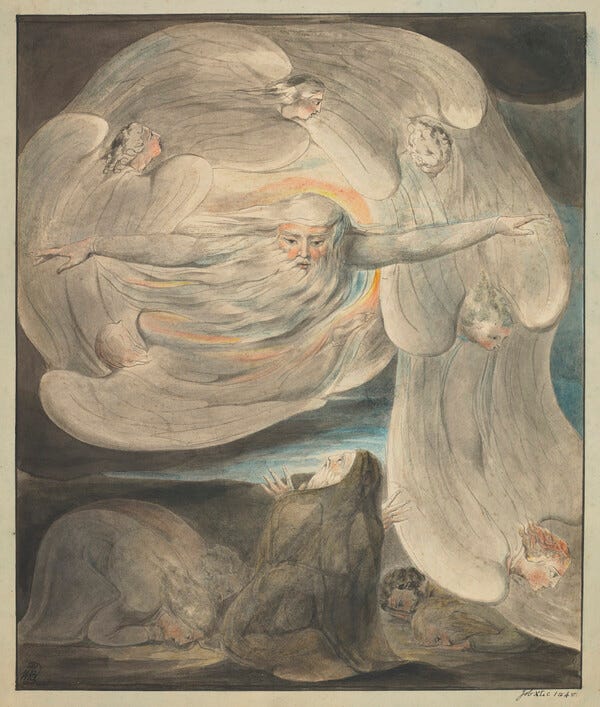
“Lord Answering Job from the Whirlwind” William Blake (1803-1805)
Who is this ...?

"With suff'ring, Job will curse you" was the devil's claim,
Now with tears of heartbreak you flood my heavenly courts,
You've lost all you valued and it is me you blame;
Your angry reasoning my righteous grace distorts.
Who is this whose doubt questions that which I decree?
A spark explains the fiery power of the sun?
A water drop defines the grandeur of the sea?
My wisdom knows no peer, my will can’t be undone,
Rest in my mighty pow’r, from your mis’ry be set free,
From bitter thoughts repent, and to my bosom run,
There yielding to my plan, be bless’d eternally
As a child sitting in church, I remember hearing sermons extolling “the patience of Job”. I also would hear the phrase used to describe people enduring life with a difficult person1 or undergoing a period of illness or a series of unfortunate circumstances. They shared this in common: suffering hardship. This phrase describing Job comes from James 5:10,11.2 There James tries to encourage his readers to maintain their hope of Jesus’ return, despite their trials. Most modern versions change patience to perseverance.
Job is an incredible biblical character. His experience of loss mirrors about the worst that could happen to someone. Despite all he suffered economically and personally, emotionally and psychologically, he displays an underlying faith in his God. (Little did he know his circumstances arose because of a strange spiritual tug-of-war between God and Satan). Job is confused by what is happening, wonders about God’s part in it. He feels abandoned by Him. Despite that, Job can still come up with some stirring proclamations of faith that have served to encourage fellow believers through the ages. He responds with incredible fortitude and faith by reasoning: “Naked I came from my mother’s womb, and naked I will depart. The LORD gave, and the LORD has taken away; may the name of the LORD be praised.” (Job 1: 21) Another example comes after losing his businesses, his children, and finally his health. He says to his wife, who instead of comforting him exhorts him to curse God and die, “You sound like one of those fools on the street corner! How can we accept all the good things that God gives us and not accept the problems?”3 Despite his demoralising conditions, he refused to renounce his faith. Yet another example comes later when, even in his confusion, and the distance he feels from God’s comforting presence, he displays a prophetic insight pointing directly to Jesus.4
In this series, I’m looking at God’s questions to humans and what we can learn from them. Earlier posts have touched on God’s question to Adam and Eve, to Cain, to Moses and then to Elijah.5
God has been listening to the back and forth conversation between Job and his friends. It has been 37 chapters of lively debate about the causes of Job’s suffering. They also touched on God’s majesty, sovereignty, and righteous justice. Their conversation gets heated and nasty in some places as Job feels he is being blamed for his circumstances while he fights to assert his innocence. The poetry is rich. The arguments intellectually and spiritually stimulating. Job isn’t too shy to ask challenging questions of God. Everyone who reads the book of Job can find great interest in what it says because suffering is part of our reality as humans. Those of us who believe in God have an even deeper need to understand where He fits in, especially when the suffering is unexpected and seemingly random.
In chapter 38, God finally has His say, but not by responding to Job’s questions. He doesn’t answer even one, choosing instead to overwhelm Job with piercing questions of his own. Someone has gone to the trouble of counting God’s questions to Job and found 77.6 Seventy-seven questions! I can imagine each one raised the temperature in the room for Job as faced the barrage of God’s rhetorical inquisition.
God’s questions all had one purpose: to remind Job of the immensity of the gap between himself and a sovereign, all-powerful, all-knowing, ever-present, supremely creative, wise God. It became clear that God owed Job no answers.
That can be hard for me to accept because it means God doesn’t owe me any either. He isn’t under any obligation to respond to all my questions “why?” with a detailed account of his purposes and reasoning. Things happen to us, or in the lives of those we love, that make no sense. “Why, Lord?” is our automatic response. The book of Job is so valuable because the issues it raises are not resolved by Job’s emotional and intellectual curiosity being satisfied, but by an undeniably personal encounter with God. That was his experience as God revealed his greatness through that torrent of rhetorical questions. Job was overwhelmed.
Eugene Peterson captured his response in his paraphrase of the passage in The Message:
Job answered God:
“I’m convinced: You can do anything and everything.
Nothing and no one can upset your plans.
You asked, ‘Who is this muddying the water,
ignorantly confusing the issue, second-guessing my purposes?’
I admit it. I was the one. I babbled on about things far beyond me,
made small talk about wonders way over my head.
You told me, ‘Listen, and let me do the talking.
Let me ask the questions. You give the answers.’
I admit I once lived by rumors of you;
now I have it all firsthand—from my own eyes and ears!
I’m sorry—forgive me. I’ll never do that again, I promise!
I’ll never again live on crusts of hearsay, crumbs of rumor.”7
Job recognised the difference between learning about God, and actually knowing Him by experiencing Him. His eyes were opened to as full an appreciation of God’s greatness as he could handle. It was life changing. He was broken by it. He was humbled by it. Having our eyes opened, even as squinting, to God’s true nature and power puts everything else into perspective. It led David to question Him: “what is mankind that you are mindful of them, human beings that you care for them?”8
I will keep asking questions of God because there are times when he kindly gives me an understanding of why and how he works in our lives. Those are a gift. But Job teaches me more, that regardless of whether I get the answers I think I need, God is worthy of my trust, my devotion, and my obedience. He is there. He is always there. The nature of my relationship with Him is as a child to his Father, but also of created with his Creator. Who am I to demand answers from the one whose greatness I am too limited to ever fully understand? Growing in my knowledge of God, in my understanding of who He is will be satisfaction enough. That should be my goal.
“Lord, teach me to trust you in every circumstance in my life, whether adverse or pleasant. Remind me of who you are in those times I may forget. Help me know you more, for knowing you is life eternal.”
I hope no one has used the phrase to describe my wife. 😃
“My brethren, take the prophets, who spoke in the name of the Lord, as an example of suffering and patience. Indeed we count them blessed who endure. You have heard of the perseverance of Job and seen the end intended by the Lord—that the Lord is very compassionate and merciful.” (New King James Version)
Easy to Read Version, Copyright © 2006 by Bible League International
Job 19:25-27 “I know that my redeemer lives,
and that in the end he will stand on the earth.
And after my skin has been destroyed,
yet in my flesh I will see God;
I myself will see him
with my own eyes—I, and not another.
How my heart yearns within me!”
Feel free to peruse them: What Are You Doing Here? question #1 for Elijah, Where Are You? question #2 for Adam and Eve, What Have You Done? question #3 for Cain, and What is That in Your Hand? question #4 for Moses.
https://www.calvarychapeljonesboro.org/articles/brace-yourself-god-has-a-few-questions-job-38-42-series
The Message, Copyright © 1993, 2002, 2018 by Eugene H. Peterson
Psalm 8:4
You might appreciate my story. The book of Job plays an important role in my story from Prodigal to Shepherd.
https://tonysmithph.substack.com/p/prodigal-to-shepherd?r=6wybrs&utm_medium=ios
Your poem is such a great hook for the insightful sermon you wrote after. When it comes to trusting God, I often turn to the story of Hosea and Gomer. He is told that he will be betrayed, that he will suffer disgrace, and yet, that God will use his life and testimony as a testament to divine grace and restoration. When we face life with wide and innocent eyes, we set ourselves up for disillusion and sometimes even apostasy. However, once we acknowledge that life will be hard, that things will bring us pain, that relationships will sour, we get at least to rest assured that God is in control and creating meaning behind the trial. In the end, just as from the very beginning, God has a plan.