
Where are You?
God's questions #2 Adam and Eve

Our countless questions wingéd fly
From earth’s crust to your ears
They range from “How?” and “What?” and “Why?”
With anger, puzzlement, and tears

 You probe our hearts with questions too
 They’re found throughout your word
 So tune my ears, my heart renew
 To learn from those your servants heard
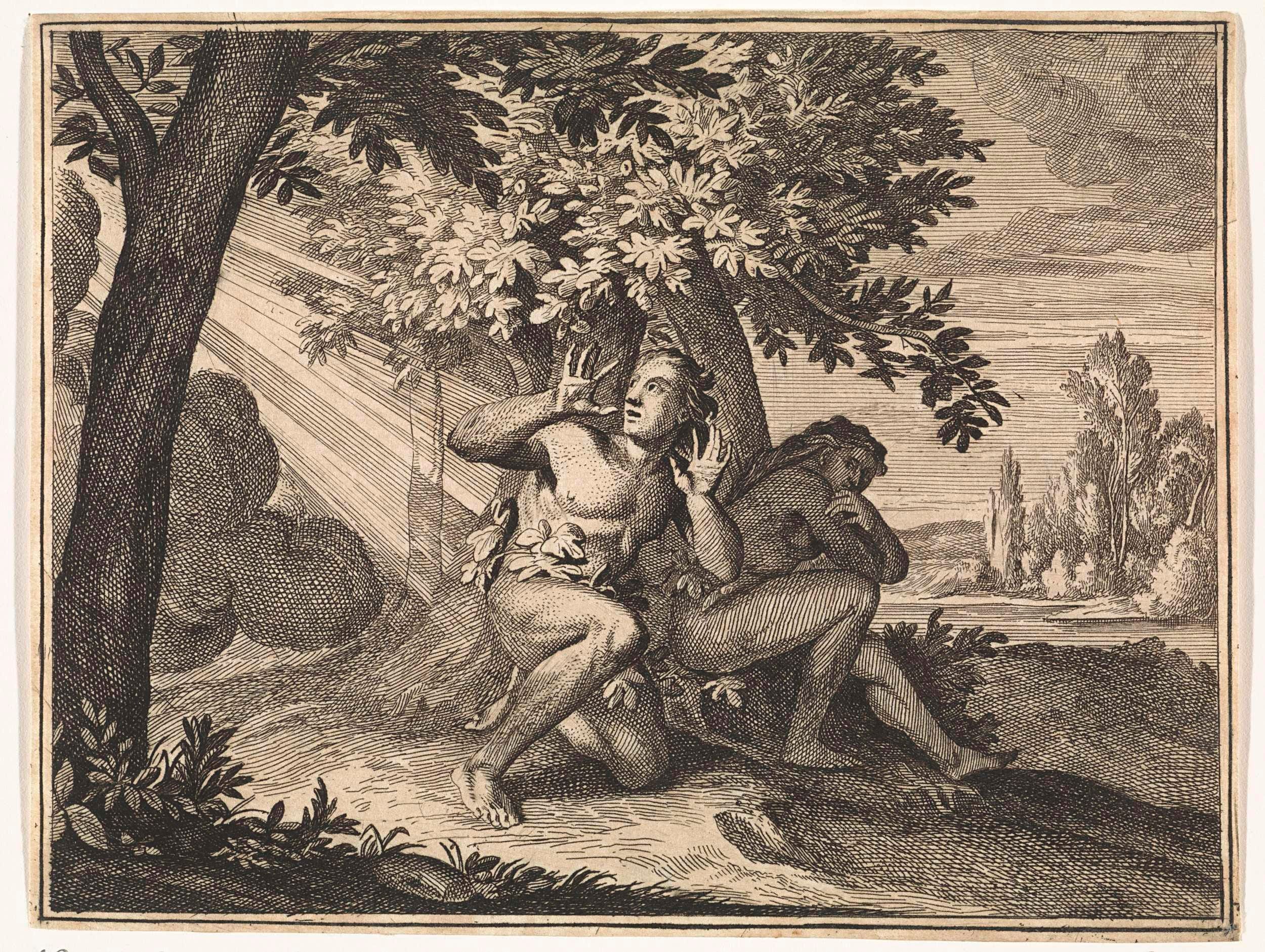
Caspar Luyken: Adam and Eve Hide From God (1712)
Where are You?
If you have read the first book of the Bible, you are aware of the story it tells of the creation of the heavens, the earth, and all that lives on the earth. You are aware, too, of the special place God gave to humans. Despite all the beauty and wonder created, we are the only beings of which God says: “Let us make humankind in our image, in our likeness, so that they may rule over the fish in the sea and the birds in the sky, over the livestock and all the wild animals, and over all the creatures that move along the ground.” So God created humankind in his own image, in the image of God he created them; male and female he created them.1
The Genesis account highlights a special relationship between The Creator, and those made in his image; we are to steward his creation. We are to enjoy it, live off it, care for it.
At the end of the first chapter, we understand that God was pleased with his handiwork and his newly established partnership with humans for it is said that: “God saw all that he had made, and it was very good.”
I won’t pretend to know how long the idyllic scene in Eden lasted before coming to a crashing end, but God’s question to Adam and Eve is occasioned by it.
For the story takes a tragic turn in chapter three when doubts about the Creator’s motives were raised in Eve’s mind by God’s enemy, appearing in the form of a serpent. He asked Eve, “Did God really say, ‘You must not eat from any tree in the garden’?” Eve corrected him by explaining they were free to eat of any tree except for one tree: “the tree of the knowledge of good and evil, for when you eat from it you will certainly die.”
The enemy then contradicted God by replying, “You will not certainly die”. With his next deceptive assertion, he questioned God’s goodness and seems to suggest that it was God’s own divine insecurity that moved him to limit their choices; “For God knows that when you eat from it your eyes will be opened, and you will be like God, knowing good and evil.”
He made what was prohibited so attractive to Eve that she ate its fruit, then shared it with Adam. Their immediate reaction to having disobeyed God was to feel shame for their nakedness. Because of their shame, they attempted to cover themselves by fashioning crude clothing with plant fronds.
The writer of Genesis then describes how this act of rebellion against God forever changed what had been a pure, unimpeded communion between the Creator and his created. That change is symbolised in the question God poses to Adam and Eve…
“Where are you?”
Where Are You?

I walk this path, just freshly made
In the coolness of the day
I’ve come to be with you awhile
And to you my thoughts relay

Yet on this day I note a change
Shame's fear now haunts the scene
It seems as though a chasm yawns
And something’s come between

I sense the gift of what we shared
Is what I must now pursue
That you are hiding and confused
Beloved, where are you?
God asks questions, not because he is lacking information, but because his questions teach truth, and are meant to make us reflect on that truth. God knew where Adam and Eve were hiding, and why they were hiding from him. It was Adam who answered: “I heard you in the garden, and I was afraid because I was naked; so I hid.”
God’s follow-up question drew out the confession from Adam and Eve that they had indeed been deceived by the serpent and disobeyed God’s instruction. Their act had brought an unhealthy, divisive, unreasonable fear of God into their lives. Their ill-advised rebellion against the Creator created distance in a relationship that had, until that moment, been harmonious and creative.
God’s question,“Where are you?”, reveals a seeking God, one who is active in building bridges. He calls those created in his image into a restored relationship. That is the God of the Bible. Someone shared this poem, The Hound of Heaven2 (written by Francis Thompson and published in 1890), with me at a time when I was asking lots of questions about God after having spent a number of years running away from the faith of my childhood. It describes a relentless God who pursues, not to enslave, but to lead us to freedom and into abundant life.
Jesus described himself as a seeking Saviour by saying, “for the Son of Man came to seek and to save that which was lost.”3
It should be encouraging for all of us that the God who gives and sustains life cares enough to describe himself as a shepherd who goes out into the wilderness, seeking high and low for one lost lamb.4
Where are you? is a question the Lord asks of each of us. We may be hiding because of the fear we have of a God we misunderstand. Or it may be caused by shame we might feel because we haven’t even lived up to our own flawed expectations of how we should behave, never mind living up to our imaginings of what God expects of us. Both believers and unbelievers can try to hide from God. I sensed God seeking me when I turned away from him as a teen, but felt an unwillingness to step into the light and be found until, years later, I grew desperate for a life of peace and purpose. Then, I fell to my knees and said: “God, I am finished running, I am finished fighting you, I give up”. I stepped out of the shadow of unbelief and into his waiting arms. That was over 40 years ago, and when I find myself slipping away from an intimate relationship with Jesus even now, I also sense his voice calling, “Tim, where are you?” Can I encourage you, if you feel you are hiding from God, he is looking for you. It is what he does. He does it because you are made in his image and he loves you. Respond to his voice and start the conversation.
* * *
The link is to a song that spoke to me as a newly restored follower of Jesus. I hope it speaks to you too.
Adam, where are you? by Don Francisco
Genesis 1:26,27
Luke 19:10
Luke 15:1-7
What a cool coincidence. I am in the process of preparing a sermon called "God, the First Missionary?" And I am discussing God's firm, gentle and probing approach to Fallen Man.
A powerful reminder that God’s questions are invitations, not accusations. It's an open hand reaching into the places we try to hide.