
Appreciating John the Baptist

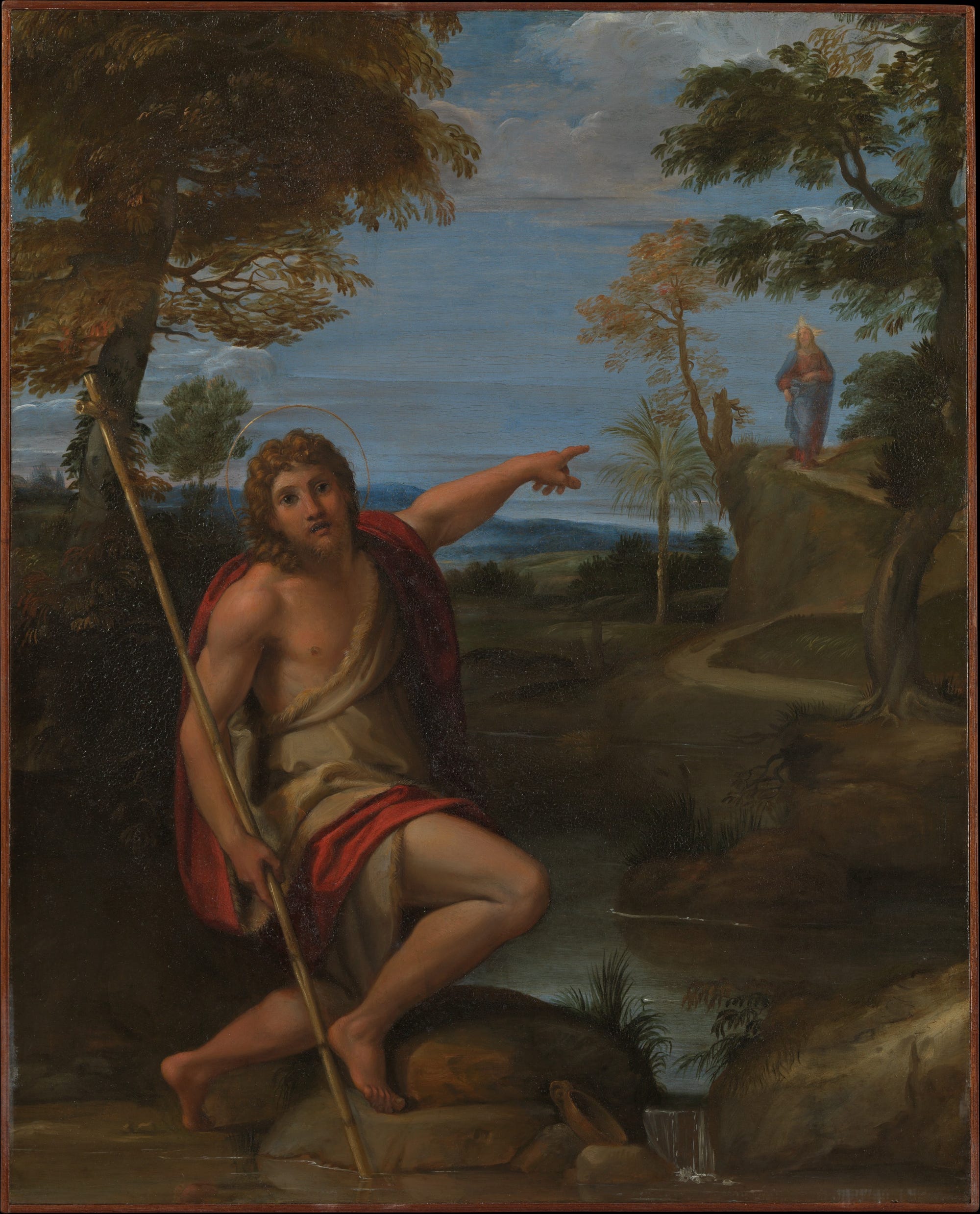
John the Baptist has always intrigued me. If I only consider the number of pages dedicated to his story, he would seem to be a minor figure in scripture. But this can’t be so, for Jesus said of him: “Truly I tell you, among those born of women there has not risen anyone greater than John the Baptist; yet whoever is least in the kingdom of heaven is greater than he.” (Matthew 11:11)
Can this be? Greater than Abraham, Moses, Joshua, David, Elijah or Daniel? They wrote books of the Bible, inspired a nation, changed history. I still have a hard time wrapping my head around that declaration. After all, what did he do that compares with some of those giants of faith?
John was born into a priestly family. Both his father, Zechariah, and mother, Elizabeth, were descendants of Aaron. Scripture tells us Zechariah served in the division, or group, of priests descended from Aaron’s son, Abijah. As one of 24 divisions of priests, it fell to his group to take its turn fulfilling its priestly duties in the temple every year, around the time of the Passover. Now, scripture also reveals that John’s parents didn’t have any children by the time we meet them in Luke 1. They wanted them, but Elizabeth was unable to conceive. Certainly this must have brought them personal sadness, and public shame (Luke 1:25). They may have wondered why God hadn’t given them what they wanted despite their righteous life. But God had another plan for this virtuous couple.
They were to get their wish, just not when they expected it. Now, well beyond childbearing age, Elizabeth was to become pregnant. God waits until Zechariah is in the temple to send an angel with the message, and the news, as happy as it is, also ignites a crisis of faith in the priest. He struggles to believe God is able to make Elizabeth pregnant at their advanced age. When he expressed his cynicism, God decided to teach him a lesson in faith and struck him mute. I guess being confronted by a celestial messenger while standing at the altar of incense in the temple wasn’t enough to convince him. Zechariah had quite the story to tell but was left unable to share it. He wouldn’t forget that encounter though and recovered his ability to speak when he broke convention to give his newborn son the unconventional name the angel had indicated he have: John.
The way his arrival was announced is enough to tip us off as to his uniqueness, and what he would become seals the deal. The angel told Zechariah he would become great in the sight of the Lord and filled with the Holy Spirit even before he was born. The spirit and power he would demonstrate in his life were compared to the great Israeli prophet Elijah and his influence in the nation. John would go ahead and prepare the way for the Lord’s arrival. His life and his words would turn the hearts of the people to God. I am sure Zechariah and Elizabeth must have recalled and spoken together about these predictions countless times as they watched their miracle baby grow into a child, and then the man we meet in the early chapters of Matthew, Mark, Luke, and John.
Considering the pre-birth noise, I find it surprising John’s role in the biblical story is limited to a few chapters. Although his arrival was much heralded, it doesn’t seem he made a huge splash at the time, and now, some 2,000 years after his death, and compared to the Apostles, Peter, John and Paul, seems a minor figure. John’s activities were limited to a condensed geographical region, for a limited time, and then he languished in prison until he was grotesquely executed in his thirties. He didn’t leave any writings behind, and in the writings of others is described in a sort of bohemian character, rejecting many social norms and contact.
But we would be missing many important lessons were we to skim over his participation in the bigger story of scripture and specifically, in Jesus’ life and ministry.
John the Baptist set the stage for Jesus. He fulfilled a valuable role as a bridge between what was, and what was to come. Like many prophets before him, his function was thankless, in that the message he had to give, while in the end hopeful, was also a bitter pill for his listeners to swallow. He lived to identify the depravity of others and call them to repentance. He wasn’t one who would lull others into a false sense of security by downplaying the reality of their standing before a holy God. He was courageous, brusque, direct, shocking, and unconventional. His goal was not to make friends, but to represent faithfully God’s point of view as God observed the nation he called his own.
John initially enjoyed some level of success and disciples gathered around him. Among them were some, including Andrew (Peter’s brother), that would walk away from him and became central to Jesus’ future ministry. His lifestyle and message grabbed the attention of a wide range of people, from religious leaders, to common folk like fishermen, and to military personnel. He didn’t go to them, but they sought him out where he was. He garnered enough interest to cause many to wonder if he was the long-awaited Messiah- a misconception he was quick to deny. He didn’t allow the renown he was gaining to distract him from his central purpose; to call people to reflect on their waywardness, estrangement from God, and then modify their attitudes and behaviours before the arrival of the coming liberator. His words encouraged people to expect the Messiah, and when Jesus appeared, he could then point them directly to him.
As noble and exemplary a person as he was before meeting Jesus, John moves into a different level of excellence afterwards.
Here are some of the things that make him one of my favourite personalities in the Bible, and one I need to learn from.
1/ His understanding of place. John never allowed himself to forget who he was and what his role was to be. He was not the Messiah. He was merely a herald for the Messiah. He was not to receive praise and glory; he was to make way for the one who was worthy of it. He told anyone who would listen: Jesus must increase and I become less. He was not to accumulate disciples and fame, influence and power- he was to let it all go.
2/ His commitment to the truth. He confronted others in their faults. He didn’t soften his message to avoid the rejection of others. This ended up getting him arrested and, after a period of incarceration, martyred. He communicated God’s message to the rich, the powerful, the strong, the weak, the poor, to anyone willing to listen.
3/ His incredible humility- he didn’t bristle when he lost his disciples to Jesus and heard Jesus was growing in popularity among the people while his influence was waning. When Jesus appeared before him, he felt unworthy of baptising him, asserting it should be the other way around. He declared himself unworthy to even be Jesus’ servant and untie the cords of his sandals. This was despite the miraculous manner of his pre-announced birth, despite being filled with the Holy Spirit from birth and despite being mentioned in the same breath as the great prophet Elijah. John never tried to take advantage of his position to call attention to himself, but always pointed to the one to come, the Saviour.
4/ His honesty- Alone in a prison cell, and with his thoughts, it appears that John started wondering if in fact he had it right, and Jesus was the Messiah he was supposed to prepare the way for. I have never been in a prison cell, but I have befriended many who have, some who have endured days and weeks in segregation, alone with their thoughts. Doubts, fears, insecurities, negative thoughts, depression, even psychosis when the isolation is extreme and prolonged- all these can make the time almost unbearable. In that primitive prison cell, probably damp, probably dark, almost certainly cold and inhospitable, is there any surprise that John may have doubted that he had it right. Even the most solid grounding in faith and an understanding of God’s purposes can be shaken when circumstances become adverse in our lives. Maybe John was asking: God, where are you? I served you as you asked, and it has cost me… was it for nothing? Why is this happening? He was honest enough to face those fears and doubts and instead of pretending they didn’t exist and protecting his legacy, sent some of his followers who had remained with him to confirm with Jesus that he was the Messiah. He had doubts, and he shared them with the only one who could resolve them.
5/ His faith- John was born with a mission. That calling defined his life and his death. He was faithful to it, at significant cost. I mean, his belief in God and in God’s call in his life got him beheaded! His faith was rewarded, not by living a long and prosperous life, or by getting married and having children who could take care of him in his old age. His faith was in part rewarded by the praise Jesus rained upon him in Matthew 11: 9-14.1
What stands out to me in the passage is that Jesus takes this opportunity to hold John up as a great prophet and servant of God. If that is Jesus’ opinion of him, I too should consider him and his heart as examples to follow. Jesus honoured him and obviously felt a great attachment to John because when Jesus was informed of John’s tragic and violent death; it seems he was deeply affected and sought solitude. It is easy for me to imagine that he needed to reflect on his cousin’s life meant and process his own sadness at his loss.
So, I finish this short appreciation of John the Baptist and what he can teach us, hoping his example will spur us on and embolden us as we follow Jesus. Like John, we who follow Jesus enjoy the presence of the Holy Spirit. Like John, we have been called to be a light, pointing to Jesus. Like John, our lives dedicated to serving God can help others reflect on their own lives and need for reconciliation with the Lord.
In so many ways John is an example of obedience to God and his call on a life. John can never lead us beyond Jesus, but he can encourage us to trust him and follow him faithfully- no matter the cost. I am sure these were the comforting words that greeted John as he entered God’s presence for eternity: “Well done, my good and faithful servant.”

Then what did you go out to see? A prophet? Yes, I tell you, and more than a prophet. This is the one about whom it is written:
“‘I will send my messenger ahead of you,
who will prepare your way before you.’
Truly I tell you, among those born of women there has not risen anyone greater than John the Baptist; yet whoever is least in the kingdom of heaven is greater than he. From the days of John the Baptist until now, the kingdom of heaven has been subjected to violence, and violent people have been raiding it. For all the Prophets and the Law prophesied until John. And if you are willing to accept it, he is the Elijah who was to come. (NIV)